How to Clean and Maintain Your Hearing Aids: A Complete Guide
Learn how to clean and maintain your hearing aids with this complete guide — a 5-minute daily routine, a weekly deep clean, and care tips for bone conduction and rechargeable models.

If you’re looking for a hearing aid for your mom or dad, you may be wondering where to start.
There are behind-the-ear models, in-ear hearing aids, open-ear designs, rechargeable devices, app-controlled models, and more. The choices can get confusing quickly.
But here’s the question that matters most:
What type of hearing aid will be easiest for my parent to use every day?
The answer isn’t simply “the smallest” or “the most advanced.” For an older adult, an easy-to-use hearing aid should be comfortable, easy to handle, simple to adjust, and matched to the situations where they actually struggle to hear.
For many older adults, a hearing aid is easier to use when it doesn’t require a complicated routine.
When comparing hearing aids for an older parent, pay attention to these five things:
The easiest hearing aid isn’t necessarily the one with the fewest features. It’s the one your parent can confidently use without feeling frustrated.
Different hearing aid styles have different advantages. The right choice depends on your parent’s hearing needs, eyesight, dexterity, comfort, and daily routine.
| Hearing Aid Type | What to Consider | May Suit |
|---|---|---|
| Behind-the-Ear (BTE) | Generally easier to see and handle than very small in-ear devices. | People who want a familiar, easy-to-handle style. |
| In-the-Ear (ITE) | Sits in the outer ear, but handling can vary depending on size. | People comfortable with an in-ear design. |
| Small In-Ear (ITC/CIC) | Less visible, but smaller parts can be harder for some older adults to handle. | People who prioritize a discreet design and can comfortably handle small devices. |
| Open-Ear | Doesn’t require the same plugged-in feeling as many traditional in-ear designs. | People who dislike having something inside the ear. |
| Bone Conduction | Delivers sound through vibrations around the ear rather than relying on the same pathway as conventional air-conduction devices. | People considering an open-ear alternative, depending on their hearing needs. |
There is no single hearing aid style that is easiest for every senior. The best starting point is the combination of hearing needs and everyday usability.
No.
Smaller doesn’t always mean easier.
If your parent has trouble seeing tiny controls or handling small objects, an extremely discreet hearing aid may actually be harder to use.
Before choosing a small hearing aid, ask yourself:
If the answer is “not really,” a slightly larger or more accessible design may be a better everyday choice.
This is one of the first things to ask before buying.
Some older adults simply don’t like the feeling of an in-ear hearing aid. Others find inserting and removing small devices frustrating.
If your parent says, “I don’t want anything inside my ears,” don’t ignore that preference.
An open-ear hearing aid may be worth considering. These designs leave the ear more open and can feel different from traditional devices that sit inside the ear canal.
Bone conduction is another option to explore. It uses vibrations to transmit sound through the bones around the ear rather than using the same air-conduction pathway as conventional hearing aids.

The BlueDeer F2H PRO combines an open-ear bone conduction design with smartphone app controls, making it an option for adults who are comfortable using their phones to adjust listening settings.
For some older adults, yes.
One of the small frustrations with traditional hearing aids is dealing with tiny disposable batteries. If your parent finds small objects difficult to handle, charging can be simpler than opening, positioning, and replacing small batteries.
But don’t stop at the word “rechargeable.”
Check how the device actually charges. A simple charging routine is what matters.
It depends entirely on your parent.
If your mom already uses an iPhone every day to text, make calls, check the weather, and watch videos, app controls may actually make adjustments easier.
If your dad rarely uses a smartphone, adding an app may be one more thing he has to learn.
So don’t choose a “smart” hearing aid simply because it sounds more advanced.
Choose technology your parent is already comfortable using.
This is a very different problem from simply needing more volume.
Think about a family dinner. Your parent can hear you when you’re sitting next to them. Then three people start talking, dishes are moving around, and someone across the table says something.
Suddenly, they’re lost.
If this sounds familiar, look for a hearing solution that addresses conversation, distance, and background noise rather than simply increasing volume.
A remote microphone can be useful in these situations. The microphone can be placed closer to the person speaking and transmit their voice to the hearing device.
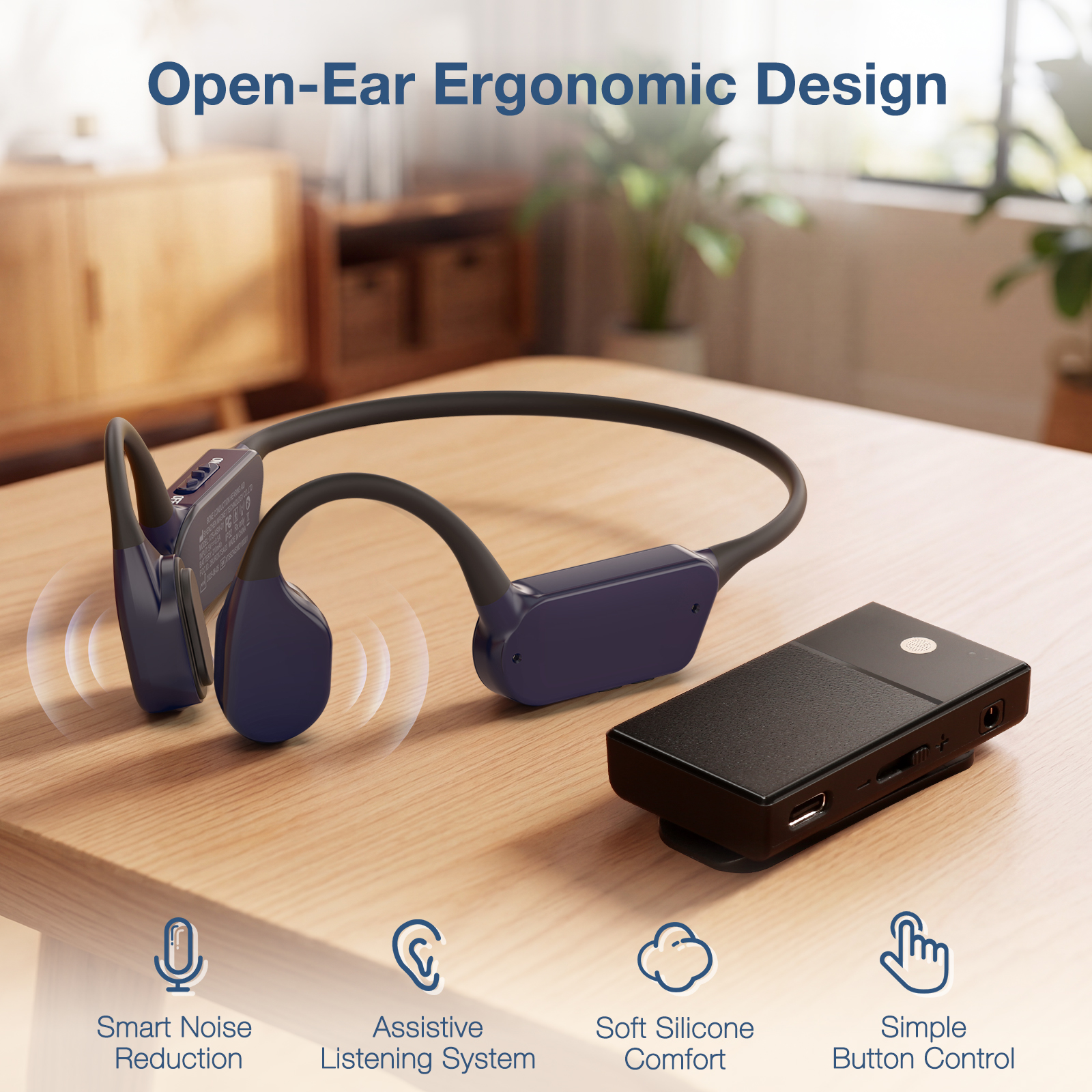
For parents who say, “I can hear people talking, but I can’t make out what they’re saying,” this type of feature may be more relevant than simply turning everything louder.
BlueDeer Advanced Bone Conduction Hearing Aid with Remote Microphone is designed with this type of conversation support in mind.
Forget the product names for a moment. Start with what happens in your parent’s daily life.
Does your parent dislike anything inside the ear?
Consider an open-ear design.
Do they struggle with tiny buttons or small parts?
Look for a device that is easy to see, hold, and put on.
Do they use a smartphone every day?
App controls may be helpful.
Do they mainly struggle at restaurants, family gatherings, or from a distance?
Consider a hearing aid that can work with a remote microphone.
Do they want something they can simply put on and use?
Keep the controls and daily routine as straightforward as possible.
There isn’t one hearing aid that is best for every older adult.
And that’s actually good news.
You don’t need to find the “perfect” hearing aid for every situation. You need to find one that matches your parent’s hearing needs, physical comfort, technology habits, and the situations where they have the most trouble.
If they dislike in-ear devices, start by looking at open-ear options.
If they enjoy using their smartphone, smart controls may be useful.
If they struggle to follow conversations in noisy places, look for remote microphone support.
If handling tiny parts is difficult, prioritize accessibility over a tiny size.
If you’re noticing a pattern rather than an occasional missed word, it’s worth taking the concern seriously.
Maybe your parent regularly asks people to repeat themselves. Maybe the TV keeps getting louder. Maybe restaurants have become exhausting because they can’t follow the conversation.
Those are good reasons to talk with a hearing professional and have their hearing evaluated.
A hearing assessment can help determine the type and degree of hearing difficulty and whether a hearing aid or another form of hearing support is appropriate.
The easiest hearing aid is one your parent can comfortably put on, operate, charge, and wear consistently. For some people that may be a traditional behind-the-ear style; for others, an open-ear or bone conduction design may be easier to accept.
They can be easier for people who dislike putting devices inside their ears. However, the right design depends on the person’s hearing needs and preferences.
Rechargeable models can be more convenient for people who don’t want to handle small disposable batteries. The charging system should still be simple enough for your parent to use independently.
They can be a good choice for older adults who are comfortable using smartphones. If your parent isn’t comfortable with mobile technology, a simpler control system may be a better fit.
That depends on where conversations become difficult. If the main problem is background noise or distance, a hearing aid with remote microphone support may be worth considering. If the main concern is comfort and ease of use, an open-ear design may be a better place to start.
Buying a hearing aid for a parent can feel like a bigger decision than buying one for yourself.
You’re not just looking at specifications. You’re thinking about whether Mom will actually wear it. Whether Dad will be able to put it on. Whether they’ll remember to charge it. Whether they’ll feel comfortable enough to keep using it.
That’s what makes ease of use so important.
Start with the moments your parent is missing—not the features on a product page.
Then choose the design that makes those moments easier to hear.