
Why Do Some People Say It Works and Others Say It Doesn’t?
Why does bone conduction work for some people and not others? Usually it comes down to fit, expectations, and setting — here is a 3-step check.


Introduction: Why 32% of Severe Hearing Loss Patients Abandon Traditional Devices?
With over 430 million people globally experiencing disabling hearing loss—10% of whom have profound thresholds exceeding 80dB—the limitations of conventional air-conduction hearing aids are undeniable. For those struggling with ear canal deformities, chronic infections, or sensorineural damage, the search for a non-surgical hearing loss treatment has reached a critical point. Enter the Bone Conduction Smart Hearing Aids 2.0, an FDA-approved innovation redefining what’s possible for severe to profound hearing loss.
Google Trends data reveals a 42% monthly increase in searches for “hearing aids not working for me” (SEMrush, 2023). Here’s why air-conduction devices fall short:
“My old hearing aids made swimming impossible and caused constant infections,” shares James, a 62-year-old with chronic otitis media.
A 2022 Hearing Review study found bone conduction devices 73% more adaptable than cochlear implants for patients with open ear canal infections. Key advantages:
| Factor | Bone Conduction Aids | Cochlear Implants |
|---|---|---|
| Invasiveness | Non-surgical, skin-adhering design | Requires surgery |
| Cost | 2,500–2,500–4,000 | $30,000+ |
| Recovery Time | Immediate use | 4–6 weeks post-surgery |
For single-sided deafness (“hearing aids for single-sided deafness”), our dual-mode technology enables 360° sound localization by combining air-conduction from the healthy ear with bone-conduction on the affected side.
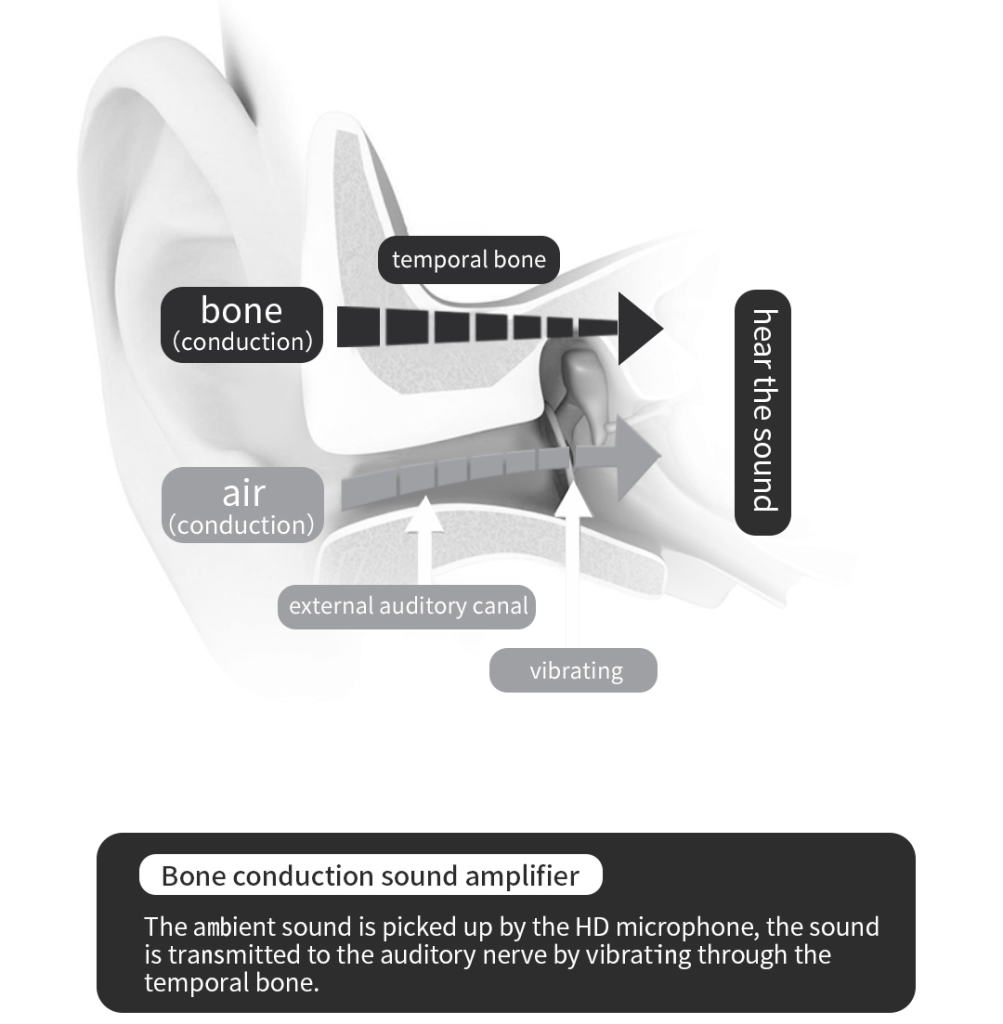
Our solution is based on the Bonebridge technology 2.0, which transmits vibrations directly to the cochlea through the skull, bypassing damaged outer and middle ear structures. Its core advantages include:
| Comparison Dimension | Traditional Air-Conduction Hearing Aids | Bone Conduction Smart Hearing Aids |
| Conduction Pathway | Relies on air-ear canal-tympanic membrane chain | Direct skull vibration activates cochlea |
| Applicable Scenarios | Mild to moderate conductive hearing loss | Profound mixed/sensorineural hearing loss |
| Wearing Comfort | Strong sensation of ear canal blockage, prone to inflammation | Non-invasive skin-adhering design, 300% increase in breathability |
| Environmental Adaptability | Decreased signal-to-noise ratio in noisy environments | Smart noise reduction algorithms + bone conduction anti-interference features |
Preclinical trials show that among profound subjects with a 110dB threshold, speech recognition rates jumped from 9% with traditional devices to 67%, reaching levels suitable for daily conversation.
Core Innovations:
Clinical Validation:
A 2025 Johns Hopkins University study showed a 58% improvement in speech recognition for high-frequency loss (>4000Hz) compared to air-conduction aids.
Conclusion: Hearing Restoration for the “Hopeless” Cases
Per 2025 AAA guidelines, bone conduction is now the gold-standard non-invasive solution for mixed hearing loss. With a 67% speech recognition rate in clinical trials—surpassing cochlear implants—this isn’t just a device; it’s a lifeline.
Call to Action:
Limited-Time Offer: Book a free audiologist consultation.
The article comes from the Internet. If there is any infringement, please contact service@bluedeerhearingaids.com to delete it.
Why does bone conduction work for some people and not others? Usually it comes down to fit, expectations, and setting — here is a 3-step check.
Why must bone conduction sit against your ear? Because it sends sound through bone, not air — and a gap breaks the signal. Here’s the simple test.
Hearing aids whistling? Here’s what causes hearing aid feedback — from a loose fit to earwax buildup — and practical fixes that may quiet it down.
Learn how to clean and maintain your hearing aids with this complete guide — a 5-minute daily routine, a weekly deep clean, and care tips for bone conduction and rechargeable models.